
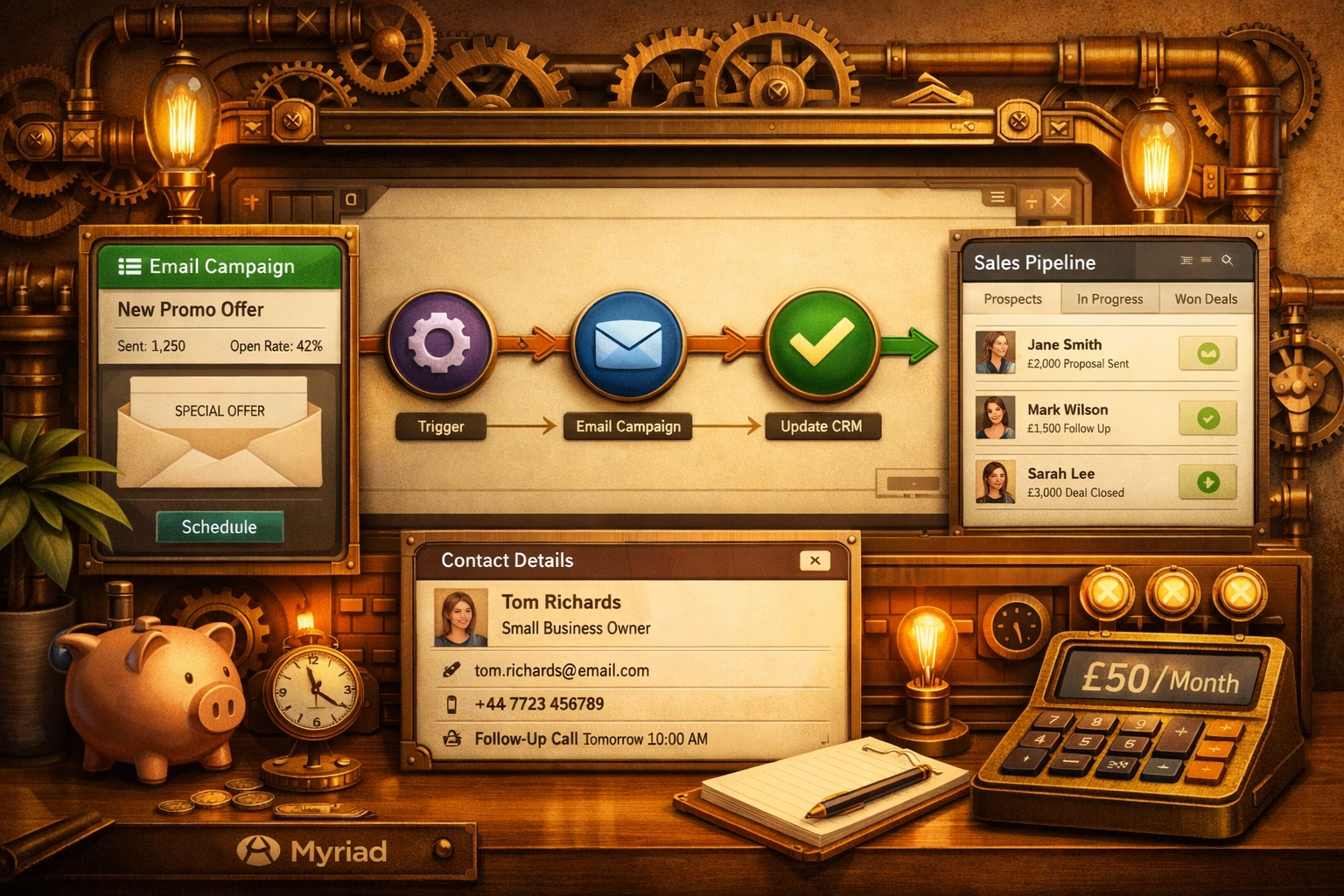
Running a small business often feels like being the captain of a Victorian steamship. You are down in the engine room, frantically shovelling coal, tightening leaky valves, and trying to keep the whole thing from exploding while also attempting to steer from the bridge. Most of us start our business journeys with a simple spreadsheet and a dream, but before long, that spreadsheet becomes a tangled web of "if this, then that" formulas that only you understand.
The common myth is that moving away from manual chaos requires a massive investment. People see those shiny enterprise software adverts and assume that professional automation is reserved for the big players with deep pockets. I am here to tell you that you can build a robust, reliable, and incredibly clever automation stack for less than the cost of a decent pair of shoes.
We are talking about moving from "firefighting" to "flow" without breaking the bank. By choosing lean, effective tools that talk to each other, you can reclaim hours of your week and finally stop the manual data entry that drains your creative energy.
The chaos of the manual engine
When you are starting out, doing things manually makes sense. You want to see every detail. You want to touch every part of the process. However, as you grow, those manual tasks become friction. Friction generates heat, and heat leads to burnout.

If you find yourself manually copying email addresses from an enquiry form into a contact list, or sending the same "thanks for your interest" email ten times a day, you are wasting your most precious resource: your focus. For neurodivergent business owners especially, these tiny, repetitive tasks are focus-killers. They are the "paper cuts" of administration that lead to executive dysfunction and overwhelm.
The goal of a shoestring automation stack is to create a series of invisible hands that do the heavy lifting for you. We want a system that acts like a well-oiled machine, quietly ticking away in the background while you focus on the work that actually brings you joy (and revenue).
Finding your central hub with Capsule CRM
Every automation stack needs a brain. This is where all your relationships, leads, and historical data live. While some CRM systems are incredibly bloated and expensive, Capsule CRM remains one of the best-kept secrets for small business owners.
It is grounded, straightforward, and does exactly what it says on the tin. It doesn't try to be a social media manager, a project management suite, and a coffee maker all at once. It focuses on relationship management. For around £15 a month for the starter tier, you get a professional place to store your contacts, track your sales pipeline, and log every interaction.
When you use a dedicated CRM instead of a spreadsheet, you stop losing track of people. You can see at a glance when you last spoke to a client and what was discussed. It removes the "mental gymnastics" required to remember where a project stands. In our shoestring stack, Capsule provides the foundation upon which everything else is built.
Connecting the cogs with Make
If Capsule is the brain, then Make.com is the nervous system. You might have heard of Zapier, which is a fantastic tool, but for those on a budget who want more flexibility, Make is often the smarter choice.

Make allows you to connect different apps and move data between them automatically. It uses a visual interface that looks a bit like a map of interconnected gears. For example, when someone fills out a form on your website, Make can automatically:
- Check if they already exist in Capsule.
- Create a new contact if they don't.
- Add a specific tag to them based on what they are interested in.
- Alert you in your internal chat or via email that a new lead has arrived.
The "Core" plan for Make starts at around £9 a month, and it is incredibly powerful. It allows for complex logic: what we call "branching": where the system can make decisions based on the data it receives. It is the digital glue that keeps your business together, ensuring that no lead falls through the cracks.
Speaking to your audience with MailerLite
Communication is the lifeblood of marketing, but you shouldn't have to manually email every person on your list. MailerLite is the "friendly megaphone" of our automation stack. It is cleaner and often much more affordable than its competitors, making it perfect for the shoestring approach.
You can use MailerLite to build beautiful newsletters, but the real magic happens with its automation features. When Make sends a new lead from your website into MailerLite, you can trigger a "Welcome Series." This is a sequence of emails that go out over several days, introducing your business and providing value without you lifting a finger.
For a small list (up to 1,000 subscribers), they even have a very generous free plan. If you need the more advanced automation features, the paid tiers start at roughly £10 a month. It is a simple, no-nonsense way to master your email marketing without needing a degree in digital marketing.
The cost breakdown of your new system
Let's look at the "back of the envelope" math for this setup. We want a powerful system that costs less than a weekly supermarket shop.
- Capsule CRM: £15/month
- Make.com (Core): £9/month
- MailerLite (Growing Business): £10/month
- Google Workspace (Basic): £5/month
Total: £39 per month.
For less than £40, you have a professional-grade system that manages your leads, automates your data entry, and handles your marketing communications. You still have £11 left over from our £50 budget, which you could spend on a booking tool like Calendly or simply keep in the bank. This is what we mean by the magical world of business automation: it is about working smarter, not spending more.
A step-by-step guide to building your first workflow
Building an automation stack doesn't have to happen overnight. You can start small and tighten the bolts as you go. Here is a simple process to get your first "shoestring" workflow up and running.
- Map your mess: Before touching any software, grab a piece of paper and draw out how a lead currently moves through your business. Where do you get stuck? Where are you manually typing things?
- Set up your hub: Start with Capsule CRM. Import your current contacts and get used to logging your notes there instead of on sticky notes or in your head.
- Connect your form: Use Make to connect your website contact form to Capsule. This is your first "win." Every time someone reaches out, they are automatically stored in your CRM.
- Add the megaphone: Connect Make to MailerLite. Now, every new lead is also added to your email list, ready to receive your welcome sequence.
- Test the engine: Send a test enquiry through your own website. Watch the gears turn. See the contact appear in the CRM and the email arrive in your inbox.
- Refine and relax: Once you see it working, you will feel a massive weight lift off your shoulders. You can then look for the next manual task to automate.

Why this approach helps the overwhelmed brain
If you are a neurodivergent business owner, or simply someone who feels perpetually "busy" but not "productive," this low-budget stack is a game-changer. Complexity is the enemy of consistency. When a system is too expensive or too complicated, we tend to stop using it.
By keeping your tech stack lean and focused, you reduce the "cognitive load" required to run your business. You don't have to learn fifty different platforms. You only need to understand how your three core cogs work together. This creates a sense of calm and clarity, allowing you to move away from the "danger zone" of business admin and back into the creative flow that made you start your business in the first place.
Building a system like this is an act of kindness to your future self. It is about setting up the "guardrails" that keep you on track even when you are having an off day. When the system handles the boring stuff, you have more energy to be human, to be present with your clients, and to enjoy your life outside of work.

Keeping the engine running
Automation is not a "set it and forget it" thing; it is a "set it and monitor it" thing. Occasionally, a digital pipe might leak or a gear might skip. However, because you have built a shoestring stack using reliable, grounded tools, troubleshooting is usually straightforward.
You don't need a team of developers to maintain this. You just need a bit of curiosity and a willingness to look under the hood every now and then. Smart systems don't have to be expensive, and they certainly don't have to be a headache. They are simply tools to help you build a business that supports your life, rather than one that consumes it.
If you are still staring at a messy spreadsheet and feeling the pressure rise, perhaps it is time to put down the coal shovel. For less than £50 a month, you can start building an engine that does the work for you. It is time to step out of the engine room and back onto the bridge.